





Organizations are moving from experimentation to deployment: embedding AI into workflows, scaling its use across teams and turning it into measurable business value.
This is where a new divide is emerging. We know that it is already happening between organizations, as some are adapting to AI faster than others. What goes more unnoticed is that this divide is also running inside companies, and even sometimes through teams themselves.
Picture 2 people reporting to the same manager. One is already using AI to automate repetitive tasks, rethink processes and take on new responsibilities. The other continues to work in the same way, while parts of their role gradually become more standardized. Give this situation a few months, and a gap starts to emerge. That gap will increasingly reflect who has access to the right tools, who has been given the opportunity to learn, and who has the time to experiment.
This is where the risk of polarization becomes clear. It is not really a question of individual talent but a question about the organization’s ecosystem that supports the people to rethink how they work. What is happening reflects that AI is changing how decisions are made, how expertise is shared, how people contribute and, ultimately, how value is created. It is a transformation that goes far beyond technology, AI is changing the work itself and the organizations around it.
AI is no longer just about technology, it is a workforce transformation
It is not the first time that technology has reshaped work before. The development of computers and the internet in the 1980’s and 1990’s was already an incredible revolution. It changed how organizations and people communicated, accessed information, and worked across distances. Machine learning then spread through businesses in the 2010s, supporting recommendations, fraud detection, translation and many other operational tasks. AI is part of this longer history of technological change.
What sets this transformation apart is the incredible speed and the extent of it. Since ChatGPT became publicly available in November 2022, generative AI has reached a much broader part of the workforce. It is entering everyday tasks while people are still doing the work: preparing decisions, sharing expertise, handling information, communicating with clients and executing processes.
The fast evolution of AI tools is pushing this shift further and changing the content of work as well as the way it gets done. While some tasks become automated, others are redesigned. New responsibilities emerge, but others disappear. And people increasingly work alongside AI systems and agents.
The numbers back up the scale of the shift. The BCG estimates that 50 to 55% of jobs could be restructured by AI over the next 2 to 3 years. The World Economic Forum estimates that 60% of today’s workforce will need significant upskilling by 2030. At the same time, 94% of business leaders report shortages in critical AI skills, while half already report excess capacity created by automation somewhere in their organization.
This situation reveals a paradox that can widen the divide if it’s not properly addressed: organizations can simultaneously have excess capacity created by automation and a shortage of the skills they need for their next stage of growth. Therefore, it raises a question for every leadership team: what to do next to prepare for this global transformation? The answer will influence whose expertise continues to carry weight, who participates in important decisions, who gets access to new opportunities and who remains concentrated on tasks that are progressively being standardized.
AI transformation puts companies on the front line
The AI transformation is evolving faster than many of the systems designed to prepare people for it. Education systems need time to change their academic programs and develop new skills, public policies need time to evolve, and even labor markets need time to adjust.
Still, specialists and various stakeholders are aware that it is a priority. In July 2026, more than 200 economists and 16 Nobel laureates recently signed the We Must Act Now statement, calling for an approach to AI that complements human capabilities and creates prosperity more broadly. As Erik Brynjolfsson, one of the statement’s organizers, put it:

“We must act now to guide AI to complement humans rather than simply imitate them, and to generate prosperity for the many, not just the few.”
Michael Spence, also one of the signatories, called for what he described as an "all hands-on deck" approach.
This statement sets out a direction: If AI is going to reshape work at this speed, workforce transformation cannot be seen as a consequence to manage later; people have to be embarked in it from the beginning.
Companies also have a direct role in deciding whether this transformation includes everyone, or only the people who were already ahead. They are where the transformation takes place every day. They are also where people can test new tools, learn new skills and gradually reshape their roles. That gives businesses a responsibility they did not necessarily ask for: they have been put in the frontline to participate in upskilling.
This subject is already recognized: 77% of companies identify upskilling and reskilling as a priority for integrating AI. But there is an imbalance visible in investment: 93% of AI investment goes to technology, while only 7% goes to the people expected to use it.
The stakes of this transformation reach beyond the deployment of tools. AI adoption is also an operational, cultural and leadership challenge. Leaders need to decide which processes should be redesigned, which responsibilities should remain with people, where AI can create value and who owns the results.
A central team can provide governance, security and shared standards. But business functions and local teams need the ability to identify relevant use cases, test them in their own workflows and take responsibility for the outcomes. This is how AI becomes part of the organization, rather than remaining a series of disconnected experiments.
What closing the divide looks like
Closing the divide requires more than a one-off course on how to use an AI tool. Learning and upskilling therefore have to become part of the transformation itself.
The goal is to help people understand how AI affects their role and experiment with it in the context of their own work. It also means identifying relevant use cases, question the outputs, test and learn with new tools. It means that they need support to redesign processes and develop new ways to create value.
The Microsoft Work Trend Index 2026 gives a name to a tension many organizations are already experiencing: the "Transformation Paradox". Among professionals using AI, 65% say they are afraid of falling behind if they do not adapt quickly. Yet 45% say they feel safer focusing on their current objectives than rethinking the way they work with AI. Only 13% say they feel rewarded when they reinvent their practices with AI, even when the results are not immediate.
The same forces that accelerate AI adoption can also hold it back. People are expected to adapt quickly, while the incentives around them often continue to reward short-term delivery and familiar ways of working.
This is why the transformation depends on organizational culture, day-to-day support and leadership. Managers need to create room for experimentation, and organizations need to recognize the effort involved in changing established ways of working.
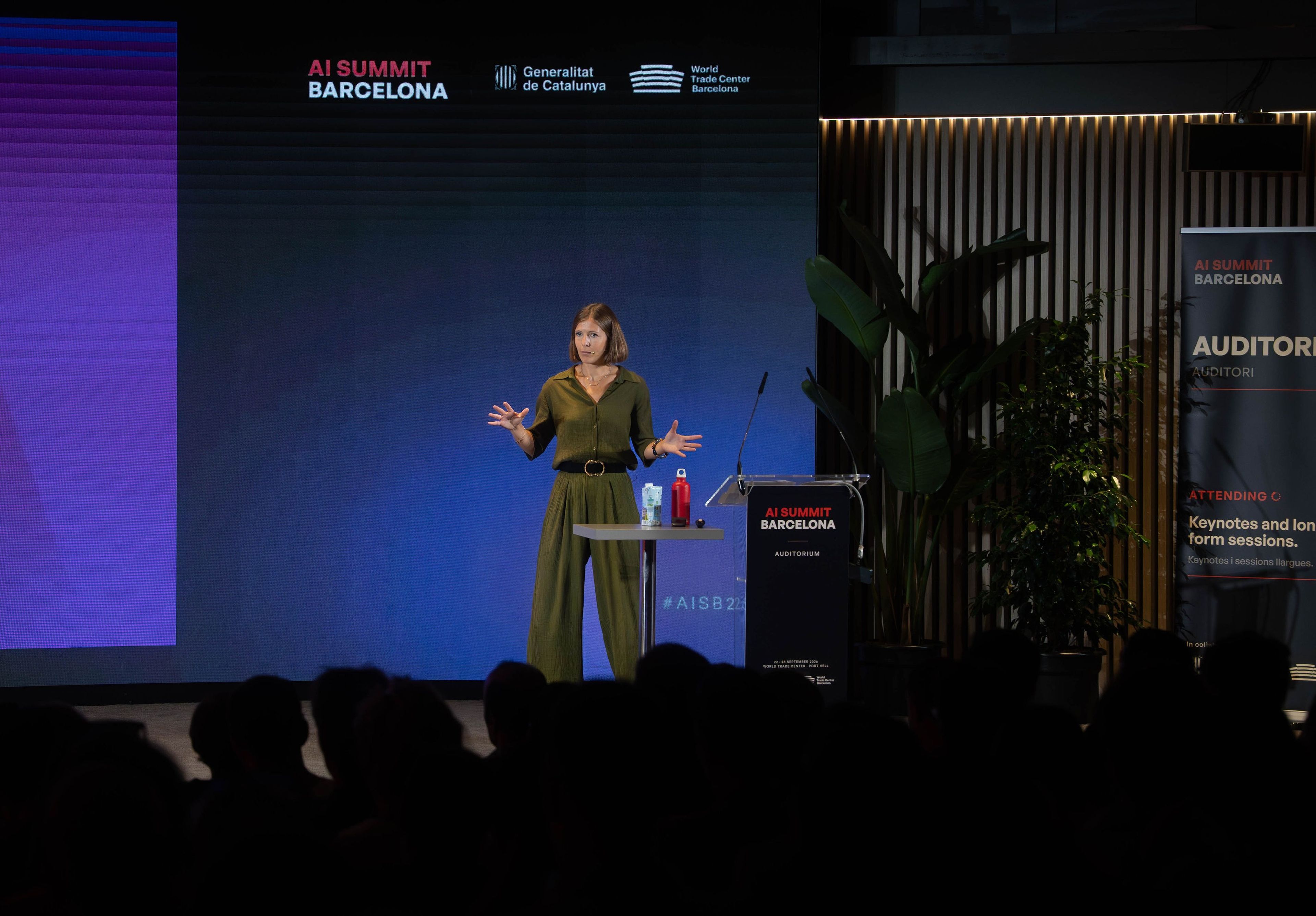
This evolution can take different forms depending on the company or the context of transformation. At Mantu, we have a Customer 0 approach: we use our own organization as a testing ground before taking solutions to our clients. Alizé Santini leads the AI transformation across Mantu, while Sara Valente, one of our AI Officers, contributes to the learning program rolled out to our 12,000 team members.
Moreover, closing the divide also calls for opening new doors. This situation is creating a demand for a new type of profile: people who can connect business expertise with technological foundations. This specialty makes them among the best profiles to lead teams in reinventing themselves. At Mantu, these profiles are called Hybrid Builders.
AI will continue to evolve. Models and platforms will change, and new capabilities will become accessible to more organizations. What will actually make the difference will come from the people who can turn those capabilities into solutions that work in real conditions.
Every major shift in work requires organizations to rethink tasks, skills and responsibilities. AI compresses that process into a much shorter timeframe and reaches directly into daily workflows.
The organizations that invest in learning, give people ownership of the change and develop profiles capable of connecting technology with real business needs will be better placed to move forward. In 3 years, organizations that succeed at reskilling at scale will have an execution advantage that others simply won’t be able to match.
AI has already changed how we work. Now what remains to decide is how organizations deal with that change and how many people they bring with them.