






Blog
Bold thinking.
Fresh perspectives.
Explore ideas and insights at the crossroads of tech, business, and human growth. We challenge norms to spark new ways forward.
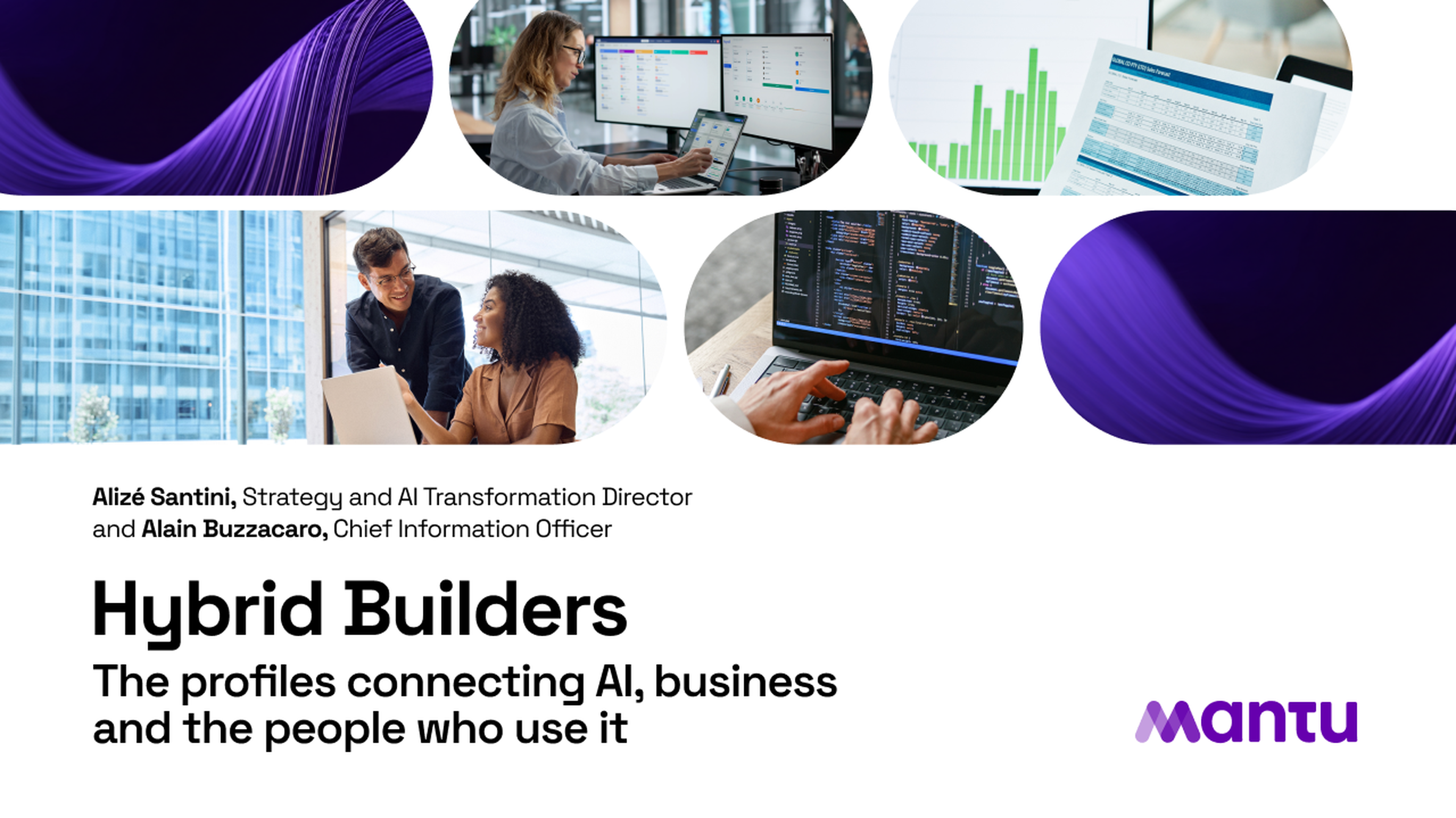 Hybrid Builders: the profiles connecting AI, business and the people who use itOct 16, 2026
AI agents can answer an HR question, qualify a request or automate part of a process. While building them is becoming easier, it’s still a challenge to make them fit and properly work inside an organization: who ensures they are compliant? Who makes sure they use tokens efficiently? And who ensures they are scalable?
 Mantu x Dust partnership: turning AI adoption into business valueOct 15, 2026
Mantu and Dust are partnering to help organizations move from AI ambition to operational use. Dust provides the platform to build, deploy and improve AI agents. Mantu brings the expertise to integrate them into business processes, transform workflows and support adoption, with the governance needed to manage usage, costs and outcomes.
 PI Planning: Objectives, Roles and Outputs for Agile EnterprisesOct 14, 2026
PI Planning brings multiple Agile teams together around a shared delivery horizon, but the event only works when preparation turns strategy into clear, feasible decisions.
This guide explains the objectives, roles and outputs that connect PI Planning to enterprise transformation and everyday delivery decisions.
 Azure DevOps for IT project management: a getting-started guideOct 13, 2026
Azure DevOps project management helps IT teams organize requirements, assign work, plan iterations, and track delivery in one shared workspace.
Azure DevOps is designed for software and technical projects. Its project-management capabilities are centered on Azure Boards, work items, backlogs, sprints, dashboards, and delivery plans.
 10 real-world Power Automate use cases to automate your business processesOct 9, 2026
Microsoft Power Automate helps teams automate repetitive tasks across Microsoft 365 and other business systems. The strongest use cases start with a clear process, a defined owner and a measurable outcome.
Power Automate can connect applications, trigger actions and route information without requiring users to repeat the same manual steps. These 10 examples show where it can support daily business operations.
 SAST vs DAST: Differences and Use CasesOct 8, 2026
Application security testing must cover both the code developers write and the software users actually run. SAST and DAST address these two perspectives, helping teams detect vulnerabilities at different stages of the software development lifecycle.
 Data Lake Architecture: Components, Layers and GovernanceOct 7, 2026
A data lake architecture defines how an organization ingests, stores, processes and governs data. It supports analytics, reporting and machine learning when ownership, quality and access are clear.
Before choosing a design, it helps to understand the main types of data architectures, including centralized, federated and data mesh models. These models shape who owns the data, who manages the platform and how governance works.
 Process Mapping: A Practical Guide to Improving Business ProcessesOct 6, 2026
Process mapping makes work visible. It shows what happens, who owns each step, where information moves and where requests wait before anyone notices.
Once the current flow is on paper, teams can discuss bottlenecks with facts instead of assumptions.
 Exchange Online Backup: The Complete Guide to Protecting Your Data Before, During and After MigrationOct 5, 2026
An Exchange Online migration needs a recovery plan before the first mailbox moves. Exchange Online protects service availability, but point-in-time mailbox recovery requires a separate backup capability such as Microsoft 365 Backup.
 How to Build ML Infrastructure: Components, Architecture, and Best PracticesOct 2, 2026
ML infrastructure connects the data, training, and serving components that turn a model into a production system. Its design depends on the workload: a fraud model answering in milliseconds needs a different setup from a demand model that runs once a day.
 Data Integration: What Is It and How Does It Work?Oct 1, 2026
Data integration combines information from multiple sources into a consistent flow. It connects databases, applications, APIs, files and data platforms so teams can use data across the organization.
To understand how data integration fits into broader architecture choices, read our guide to the main types of data architectures, including centralized, federated and data mesh models.
 AI Summit Barcelona: "The rise of Hybrid Builders", the keynote of Constance Nevoret, co-CEO of MantuSep 30, 2026
At the AI Summit Barcelona 2026, Mantu Co-CEO Constance Nevoret shared a perspective on the rise of Hybrid Builders, a new type of profile that will shape the next phase of AI transformation.