







In an era where controlling the sky and exploring space have become critical, aerospace industries see their market becoming extremely advanced and highly competitive, more than ever. This ecosystem is always in need of experts bringing innovative ways to develop the sector, in order to remain at the forefront of technology.
Competition is fierce, but this is where Building Information Modeling (BIM) consultants take action. The goal is simple and complex at the same time: how to bring new innovations in the aerospace sector to stand out from other actors?
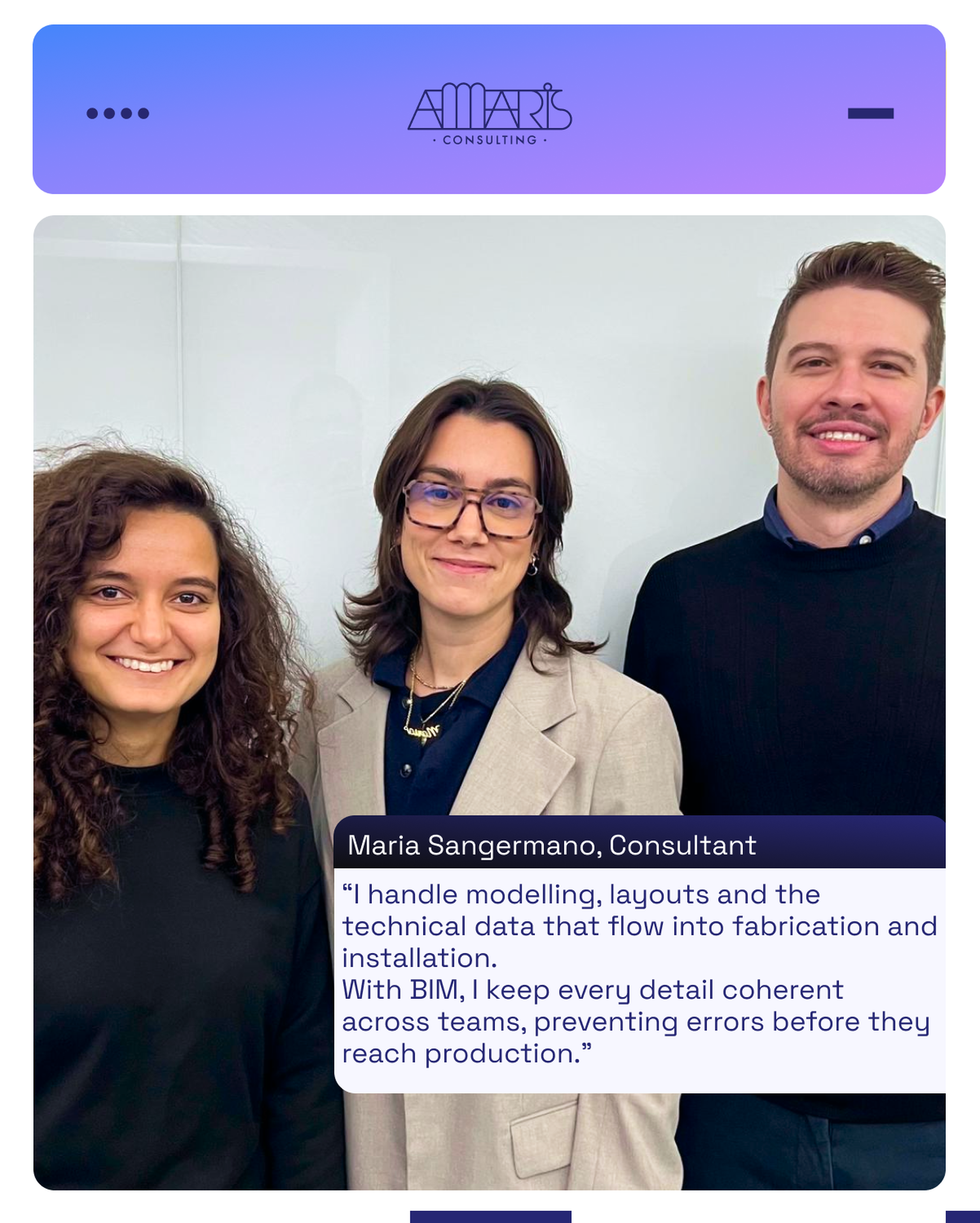
Ideas can come from concepts and patterns, but also from experience: this is the case of BIM consultant Maria, who began her career in architecture, a field quite different from the aerospace sector she now works in. Her strength lies in her ability to translate expertise from one sector into a clear vision for another one.

As a result, I was able to transfer and leverage the skills and knowledge acquired in the past, applying them successfully in a new professional context.
What is a BIM consultant?
Basically, a BIM consultant helps deploy BIM services in companies, which are modeling platforms allowing them to create smart digital 3D representations that imitate all the characteristics of the object concerned.
In the context of Maria's work, she transferred her knowledge of BIM technologies from the architecture industry to the aerospace one. Deploying such tools is a combination of many steps, especially in this industry:
Define and deploy the company or client’s BIM strategy
Support teams on BIM projects
Draft BIM procedures, standards and conventions
Ensure the quality and conformity of digital models
Advise on the choice and use of BIM tools
Train users and support change
Optimize collaborative processes and dataflows
This methodology, when applied in a structured and consistent way, is a key element in my current work.
Even though the architecture field provides a more technical experience, where BIM tools are mostly used for authoring activities and coordination phases, it is quite useful in the aerospace industry.
The specificity of the aerospace
Like any other industrial field, the aerospace comes with its own set of challenges linked to continuous technological evolution and the increasing complexity of systems. However, it is also a matter of extremely high levels of safety and reliability conflicts with increasingly rapid development timelines and strong cost pressures.
That is why advanced tools, such as artificial intelligence, digital twins, and new materials require constant skills development. Here, using BIM methodology that integrates detailed and real-time information enables optimal resource management, more accurate planning, and a reduction in errors.
Moreover, BIM tools are made to identify and resolve issues during the design phase, thus preventing costly modifications during construction. All of these elements result in a highly versatile role that spans many aspects of this large sector in terms of responsibilities.
I really enjoy being able to move from modelling to layout definition, all the way to data extraction and the production of technical drawings that go directly to the site.
Discover our opportunities in aerospace
Not only a methodology, an easier collaboration
The work of a BIM consultant does not stop at only improving the ergonomics of the production process: there are several positive side-effects on the way to collaborate too.
This approach greatly improves coordination among all stakeholders, as it allows every relevant piece of data to be stored and communicated clearly in an organized way throughout the subsequent phases of the process.
In addition, Maria has participated in many different projects with different teams, and the assessment is clear: the visual and informational support of the BIM technology facilitates dialogue, the review of design choices, and the timely identification of potential issues. This way, it is made possible to intervene quickly with shared solutions.
The career of a BIM consultant at Amaris Consulting
My experience at Amaris Consulting has allowed me to deepen several topics related to the sector, thanks to a dynamic role that adapts to the specific needs of each project.
The relationship between Amaris Consulting and the aerospace sector is genuine: there is a strong support of this ecosystem by adopting a strategic approach based on specialized expertise, operational flexibility, and continuous innovation. According to Maria, these structured project management and systems engineering methodologies are essential to help companies improve the management of requirements, safety and quality.
Flexibility is a key factor of the BIM consulting experience at Amaris Consulting: the opportunity to work on different activities and to follow multiple phases of the design process leads to a great expansion of technical skills and a noticeable improvement of the ability to manage diverse responsibilities in complex environments.
Besides flexibility, a certain rigor is yet necessary. Standards and well-defined guidelines ensure that all information inserted in the model is consistent, reliable, and genuinely useful for the overall development of the work. These directives help maintain a high-quality standard and ensure that every phase of the process is traceable and verifiable.
Thus, Amaris Consulting knows how to strike the right balance between autonomy and structure in the aerospace industry, both essential for what a BIM consultant has to deliver at the end of a project.
What we are looking for
Technical as well as interpersonal skills are mandatory for this function:
Proficiency in BIM software
Construction and engineering knowledge
Data management and digital collaboration
Communication and stakeholder management
Project management skills
Problem-solving and analytical thinking
Of course, business development and consulting skills are highly recommended.
Some similar or different roles wait for you at Amaris Consulting, all fulfilling in their own way. Join our team in aerospace.